How Junk Hauling Companies Really Price Fence Removal
Wondering what fence removal will really cost? Learn how junk haulers price fence piles based on volume, weight, and access so you can get a clear quote.
How We Price a Real Fence Removal Job
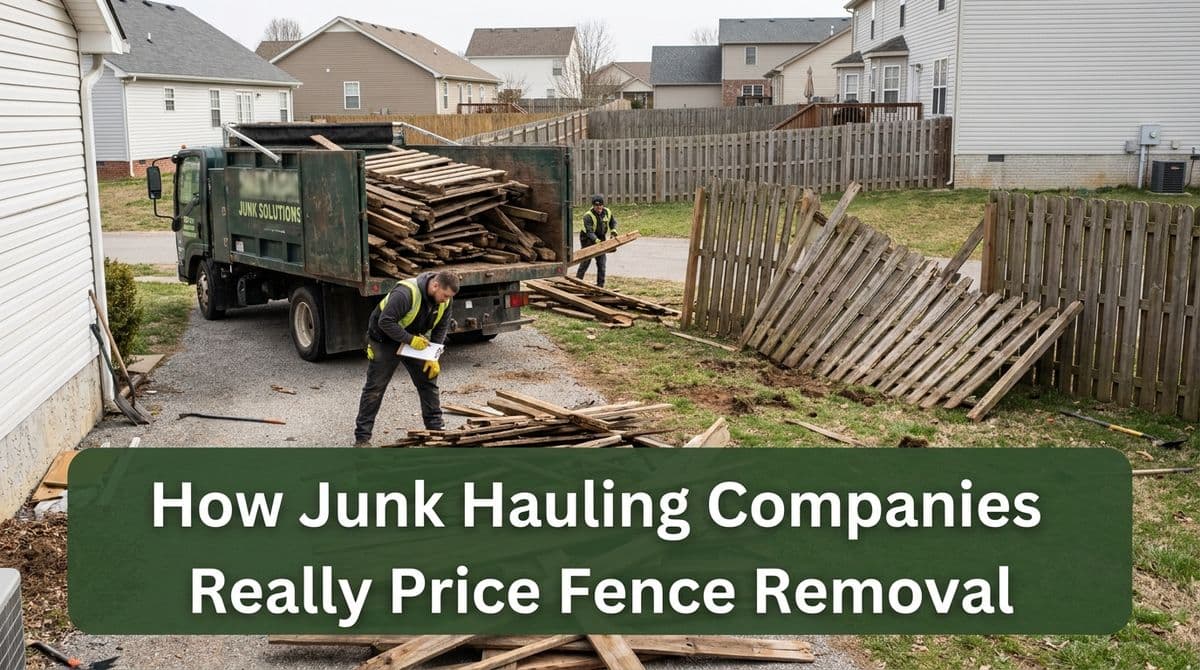
We recently got a call from a customer — let’s call him Frank — who was staring at a big, messy pile of old fence panels in his backyard. He’d already done the hard part: repairing sections of his fence over time, pulling down the old boards, and stacking them in a heap. Now the pile was waist-high, about four feet wide, made up of six-foot boards with some 4x4 posts mixed in. It had to go.
Frank’s main question was simple: “How do you price something like this?” He didn’t know the exact linear footage, just that it was a big pile of wood in the backyard with decent access through a gate and no stairs. We walked him through exactly how we think about jobs like his, what information we look for, and what affects the price.
Since a lot of homeowners are in the same situation — a growing pile of old fencing, but no idea what it will cost to haul away — we thought it would be helpful to share how companies like ours price fence removal jobs and what you can do before you call to get a clear, accurate quote.
The Basics: What Junk Haulers Look At First
When someone like Frank calls about fence removal, we’re really looking at three big things:
- How much material there is (volume and approximate length)
- How heavy it is (especially posts, nails, or wet wood)
- How easy it is to access (how close we can get our truck or trailer)
Frank didn’t know his linear footage, and that’s common. What he could tell us was that the pile was about waist-high, four feet wide, made of six-foot boards, plus some 4x4 posts with no concrete attached. That gave us a helpful mental picture, but we still wanted more detail.
So we asked him to text over some photos from a few different angles. Pictures let us estimate not just the volume of the pile, but how it’s stacked, where the nails and screws might be, and how far we’ll have to carry it.
Why Access Matters So Much
One of the first questions we asked Frank was, “Is the pile in the backyard, or right next to the driveway?” That’s not just small talk — access can make a big difference in price.
In Frank’s case, the pile was in the backyard with a gate leading to a greenbelt area. There was a short fence at the back, but we could park a truck or trailer behind it and toss material over. The pile was about 40 feet from where we could park, with no stairs and only a small hill to the front yard as a backup route.
Here’s how access usually affects pricing:
- Best case: Pile is next to the driveway or alley; we can back right up and load. Lowest labor time, best pricing.
- Good case (like Frank’s): We can get reasonably close through a gate or back area, maybe 30–50 feet of carrying.
- Challenging case: Long carries from the backyard, tight gates, stairs, or steep slopes. More time and labor, so the price is higher.
When you call, be ready to describe how close a truck can get and any obstacles between the pile and the parking spot. That small detail helps us give a more accurate quote up front.
Volume, Weight, and What’s in the Pile
Most junk hauling companies price by volume (how much space your material takes in the truck), with weight and disposal fees as secondary factors. Fence removal is no different.
With Frank, we asked clarifying questions like:
- “How high is the pile compared to you?” (waist-high)
- “Roughly how wide and long is it?” (about four feet wide, several sections long)
- “Are there 4x4 posts?” (yes)
- “Any concrete still attached to those posts?” (no)
Those last two questions matter more than people realize. Wood fence boards alone are relatively light and easy to handle. Once you add posts set in concrete, you’re dealing with heavy, awkward pieces that are harder on our crew and our equipment and can increase disposal costs.
If you’re looking at your own pile, try to note:
- How many sections of fence are there (roughly)?
- How high is the stack (ankle, knee, waist, or chest-high)?
- Are there posts, and do they have concrete on the ends?
- Is it just wood, or is there metal, hardware cloth, or wire mixed in?
Why We Ask for Photos Before Quoting
When we first spoke to Frank, we didn’t throw out a price on the spot. Instead, we asked him to text pictures of the pile, the gate, and the access from where we’d park. That might feel like an extra step, but it protects both you and us.
Photos help us:
- Confirm the size of the pile versus how it’s described over the phone
- Spot hidden challenges, like loose nails or tangled wire
- See actual access conditions: tight corners, low branches, narrow gates
- Give you a realistic price range before we show up
From your side, sending pictures means you’re far less likely to be surprised by the final bill. The more accurately we can see the job up front, the closer our estimate will match the final price.
How to Get the Clearest Quote Before You Call
If you’ve got a pile like Frank’s and you’re about to reach out to a junk hauling company, a little prep goes a long way. Here’s what we recommend having ready:
- Basic measurements: Rough length, width, and height of the pile.
- What’s included: Boards only, or boards plus posts? Any concrete?
- Access details: Distance from the pile to where a truck can park, presence of stairs, slopes, or tight gates.
- Photos: A few clear shots from different angles, plus a shot showing the path from the pile to the parking spot.
- Timing: When you’d like the work done and any schedule flexibility.
Frank told us he was retired and home most days, so timing was easy. If you have tighter windows, mentioning that early helps us schedule you efficiently and sometimes even save you money by grouping you with other nearby jobs.
What Homeowners Should Expect on Fence Hauling Day
Once you approve a quote, the actual hauling process is usually straightforward. For a job like Frank’s, here’s what the day typically looks like:
- We arrive within the scheduled window and walk the site with you.
- We confirm the pile matches what we saw in the photos and finalize the price before loading.
- Our crew loads the boards and posts, working from the farthest pieces back toward the truck.
- We do a final sweep and magnet check (if needed) for nails and debris.
- We settle payment and haul everything off for proper disposal or recycling.
By the time we’re done, that frustrating pile that’s been staring at you for months is gone, and you’ve got your yard back.
If you’re looking at a heap of old fencing and don’t know where to start, gather a few measurements, snap some photos, and give a local junk hauling company a call. With the right information up front, you can get a clear, fair price and a smooth, stress-free fence removal experience.